
Large-scale civil litigation plays a critical role in addressing harm caused by defective products, dangerous drugs, toxic exposures, and systemic corporate negligence. When hundreds or even thousands of individuals are injured under similar circumstances, the traditional one-plaintiff-one-defendant model becomes inefficient and unsustainable.
To address these challenges, the legal system provides mechanisms such as mass torts and class actions—tools designed to streamline litigation, conserve judicial resources, and provide a path to compensation for affected individuals.
This article explores the structure, strategy, and application of mass torts and class actions. It also outlines related forms of litigation and examines high-profile cases that have shaped the field. The goal is to provide a clear and practical understanding of how complex litigation functions in today’s legal landscape.
What Is a Mass Tort?
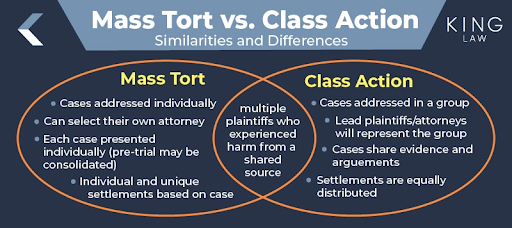
A mass tort is a civil action that arises when a large number of plaintiffs file individual claims against one or a few defendants for harm caused by a common product, practice, or event. These cases are consolidated for efficiency, often through Multidistrict Litigation (MDL), but each plaintiff retains their own separate legal claim.
Unlike a class action, a mass tort recognizes that while the defendants and legal issues may be similar, the extent of injury, medical history, and damages vary from person to person, warranting individualized consideration.
Common Examples of Mass Tort Triggers:
- Defective pharmaceutical drugs (e.g., opioids, Zantac)
- Faulty medical devices (e.g., hip implants, hernia mesh)
- Environmental or toxic exposure (e.g., asbestos, PFAS)
- Hazardous consumer products (e.g., talcum powder)
Legal Characteristics of Mass Torts
Mass torts often begin when regulatory bodies or scientific studies reveal a risk tied to a specific product or action. Plaintiffs, often hundreds or thousands, file lawsuits in various jurisdictions. To manage these efficiently, courts may centralize them into MDLs under 28 U.S. Code § 1407.
Key features include:
- Individual Representation: Each plaintiff is represented by counsel and must prove personal injury and damages.
- Discovery Efficiency: Discovery is conducted collectively to reduce duplication.
- Bellwether Trials: A small number of cases are selected to proceed first, helping predict trends for settlement or litigation strategy.
- Variable Outcomes: Some plaintiffs may settle, others may proceed to trial, and some may be dismissed.
What Is a Class Action?
A class action is a procedural device that allows one or more plaintiffs (known as class representatives) to file a lawsuit on behalf of a larger group of individuals (the class) who have experienced identical or very similar harm resulting from the same conduct by a defendant.
The case proceeds as a single lawsuit, and any judgment or settlement applies to all class members, unless they formally opt out.
Before a case can proceed as a class action, it must be certified by a court. Certification is governed by Rule 23 of the Federal Rules of Civil Procedure and requires meeting specific criteria:
- Numerosity: The class is so large that joinder of all members is impractical.
- Commonality: Legal or factual questions are common to all members.
- Typicality: The claims or defenses of the class representatives are typical of those of the class.
- Adequacy: The representatives will fairly and adequately protect the interests of the class.
Source: https://www.robertkinglawfirm.com/mass-torts/
Structural Comparison: Mass Tort vs. Class Action
| Aspect | Mass Tort | Class Action |
| Plaintiff Type | Individual plaintiffs | Class of similarly situated plaintiffs |
| Case Management | Consolidated via MDL (often federal) | Single unified case |
| Damages | Evaluated individually | Shared among class members |
| Trial Strategy | Bellwether trials guide litigation | Tried once for the entire class |
| Common Uses | Pharmaceutical, toxic exposure, product defect | Consumer fraud, data breaches, wage disputes |
| Opt-Out Option | Not needed—each case is separate | Must opt out if not wanting to participate |
Other Types of Civil Litigation
Beyond mass torts and class actions, civil law includes numerous forms of litigation, each with its own procedural rules and standards of proof.
1. Personal Injury Lawsuits
Filed by individuals injured due to negligence, recklessness, or intentional misconduct. Common in automobile accidents, workplace injuries, and premises liability cases.
2. Product Liability
Involves injury from a dangerous or defective product. Plaintiffs may sue based on:
- Design defects
- Manufacturing defects
- Failure to warn (marketing defects)
3. Medical Malpractice
Occurs when healthcare providers fail to meet the standard of care, resulting in patient harm. Requires expert testimony, medical records, and causation analysis.
4. Toxic Tort
A subtype of personal injury involving exposure to harmful substances such as asbestos, lead, benzene, or perfluoroalkyl substances (PFAS). Frequently develops into mass tort litigation due to widespread exposure.
5. Wrongful Death
Filed by surviving family members when an individual dies due to negligence or misconduct. Damages may include funeral expenses, loss of income, and loss of consortium.
Notable Mass Tort Cases and Their Outcomes
1. Opioid Litigation
- Defendants: Purdue Pharma, Johnson & Johnson, McKesson, others.
- Claims: Manufacturers and distributors allegedly misled the public about addiction risks and fueled the opioid epidemic.
- Outcome: Purdue Pharma filed for bankruptcy and proposed a $6 billion settlement. Johnson & Johnson and others reached a $26 billion nationwide settlement in 2022.
2. 3M Combat Earplugs
- Defendants: 3M Company.
- Claims: Issued defective earplugs to U.S. military personnel, leading to hearing loss and tinnitus.
- Outcome: In 2023, 3M agreed to a $6.01 billion global settlement for over 250,000 claims—one of the largest MDLs in U.S. history.
3. Roundup Weed Killer
- Defendants: Monsanto (owned by Bayer)
- Claims: Glyphosate in Roundup linked to non-Hodgkin’s lymphoma.
- Outcome: Bayer reached a $10+ billion global settlement to resolve roughly 95,000 cases, while still facing thousands more.
4. Talcum Powder Cases
- Defendants: Johnson & Johnson
- Claims: Long-term use of talc products allegedly linked to ovarian cancer and mesothelioma.
- Outcome: J&J proposed an $8.9 billion bankruptcy settlement to resolve approximately 38,000 lawsuits.
5. Camp Lejeune Water Contamination
- Claims: Veterans and residents exposed to toxic water at the U.S. Marine Corps Base suffered from cancers and other illnesses.
- Legal Framework: Enabled under the Camp Lejeune Justice Act of 2022.
- Status: Thousands of administrative claims and lawsuits are currently pending under MDL oversight.
Terminology Frequently Associated with Complex Litigation
- MDL (Multidistrict Litigation): Federal process to consolidate related cases for pretrial proceedings, improving efficiency and consistency.
- Bellwether Trial: Early trial used to test legal arguments and case value, influencing settlement negotiations.
- Punitive Damages: Additional damages awarded to punish egregious or willful misconduct.
- Contingency Fee: Legal fee structure where the attorney is paid only upon winning or settling the case.
- Opt-Out Rights: In class actions, members may choose to exclude themselves from the settlement or judgment.
- Preemption: A legal doctrine often raised in product liability cases, where federal law is claimed to override state claims.
- Daubert Standard: Governs admissibility of expert testimony in federal courts, critical in toxic tort and pharmaceutical cases.
Final Analysis
Mass torts and class actions are powerful procedural tools designed to manage large-scale civil claims. While both serve to aggregate claims against common defendants, they differ significantly in structure, strategy, and outcomes.
Mass torts preserve individual plaintiff autonomy, making them suitable for cases involving variable injuries and damages, such as those related to pharmaceuticals or toxic exposure. Class actions, on the other hand, offer judicial efficiency and uniform resolution when the injuries and facts are substantially the same across plaintiffs.
As litigation evolves, particularly in areas like environmental law, pharmaceutical regulation, and consumer protection—mass torts and class actions will continue to serve as essential mechanisms for systemic accountability.
Firms handling these matters must remain vigilant in procedural strategy, scientific analysis, and client communication, given the high stakes and complex nature of such cases.


